Before You Toss That Broccoli Leaf: The Case for Cooking Your Kitchen's 'Waste'
Somewhere between the farmers market haul and Thursday night's dinner, most of us quietly throw away a third of the food we buy. Not because we're careless—because nobody ever showed us that broccoli leaves taste like a milder collard green, or that the parsley stems you're discarding carry more flavor than the leaves on top.
Root-to-stem cooking sounds like a restaurant trend or a sustainability slogan, but at home it's really just a habit shift. And for anyone trying to eat healthier on a real-world budget, it might be the most underrated nutrition move available.
The Nutrition Hiding in the Trash
Start with the parts we've been trained to skip. Broccoli leaves contain notable amounts of beta-carotene and vitamin A—arguably more per gram than the florets everyone fights over. Watermelon rind holds citrulline, an amino acid studied for its role in blood flow. Citrus peels carry most of the fruit's fiber and a concentration of flavonoids that the juicy interior can't match.
Even herb stems, the thing every recipe tells you to 'pluck and discard,' are perfectly edible in most cases. Cilantro and parsley stems are tender enough to blitz into sauces; thyme and rosemary stems are woody, sure, but they're ideal for infusing stocks and oils before fishing them out.
The point isn't that peels are magic. It's that our default assumption—interior good, exterior garbage—doesn't hold up to scrutiny.
Build a Weekly Scrap Audit
Here's the system that actually changes behavior: once a week, before your trash goes out, open the bag and look. That's it. Call it a scrap audit.
You'll start noticing patterns. Maybe it's half an onion sweating in a produce bag. Three carrots gone rubbery. The stems from Sunday's herb bunch. Once you see what you consistently toss, you can set up a small counter system to intercept it:
- A freezer bag for stock scraps. Onion ends, carrot tops, celery leaves, garlic skins (yes, they're fine—they add color), herb stems. When the bag fills, you have stock ingredients waiting.
- A 'eat me first' bowl on the counter or front row of the fridge for produce on the edge.
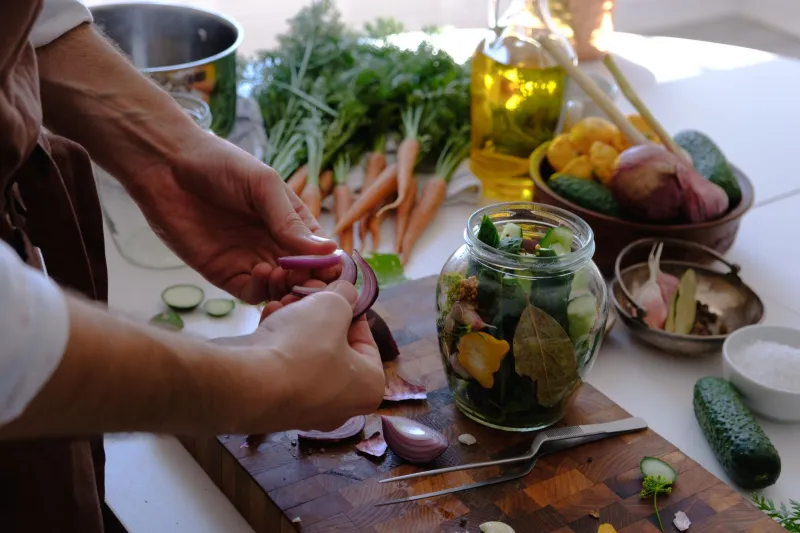
- A quick-pickle jar in the fridge for limp vegetables—carrots, radishes, red onion, jalapeños. Vinegar, water, a spoonful of sugar, salt. Done in ten minutes, good for weeks.
The audit isn't about guilt. It's about noticing, which is the first step of every good cooking habit anyway.
Four Frameworks, Not Recipes
Strict recipes don't work well with scraps because scraps are unpredictable. Frameworks do. These four cover about ninety percent of what lands in a typical American crisper drawer.
1. The Any-Veg Frittata. Wilting spinach, roasted vegetable odds and ends, that lonely half zucchini—sauté whatever you have, pour in six beaten eggs with a splash of milk and a handful of cheese, and bake at 375°F until set. Leftovers reheat beautifully, which makes it a meal-prep anchor.
2. The Everything Stock. Fill a pot with your freezer scrap bag, cover with water, add a few peppercorns and a bay leaf, simmer an hour, strain. Freeze in quart containers. Homemade stock is the backbone of soups, grains, and pan sauces—and it costs you nothing but the stove time.
3. The Stem-Forward Pesto. Swap basil for whatever needs using: parsley stems, arugula past its prime, even carrot tops. Blend with garlic, nuts or seeds, olive oil, lemon juice, and parmesan. Toss with pasta, spoon over grain bowls, or thin it into a salad dressing.
4. The Overripe Fruit Plan. Bananas gone spotty go straight to the freezer for smoothies or quick bread. Soft berries become a two-ingredient compote—fruit plus a squeeze of honey, simmered ten minutes—that upgrades yogurt, oatmeal, and pancakes for the whole week.
A Few Things Worth Knowing
Not every scrap deserves a second life. Potato skins that have turned green should go, as should anything moldy (a fuzzy spot on soft produce means the whole thing goes; on hard cheese, you can cut an inch around it). And peels only make sense if you're buying produce you'd wash thoroughly anyway—conventional or organic, a good scrub under running water handles most of it.
The rind question deserves special mention. A wedge of parmesan rind, the part most of us bin without thinking, is a soup secret weapon. Drop it into a pot of beans or minestrone and it melts into a savory, umami-rich depth that no bouillon cube can fake. Keep a bag of them in the freezer like the stock scraps.
Small Shifts, Compounding Returns
Nobody overhauls their kitchen in a weekend. But the scrap audit costs five minutes a week. The freezer bag costs nothing. The frittata is already dinner you'd be making anyway.
What starts as waste reduction tends to become something better: a more confident, more resourceful way of cooking. You stop treating ingredients as fragile and start asking what they can become. That mindset—curious, flexible, a little frugal—is the real foundation of eating well for the long haul.
And it starts with one broccoli leaf you didn't throw away.